
Honors
-
In February 2021, the University of the District of Columbia (UDC) announced it will rename its sports complex after Dr. E.B. Henderson, the acknowledged "Father of Black Basketball."
-
Description text goes here
-
Description text goes here
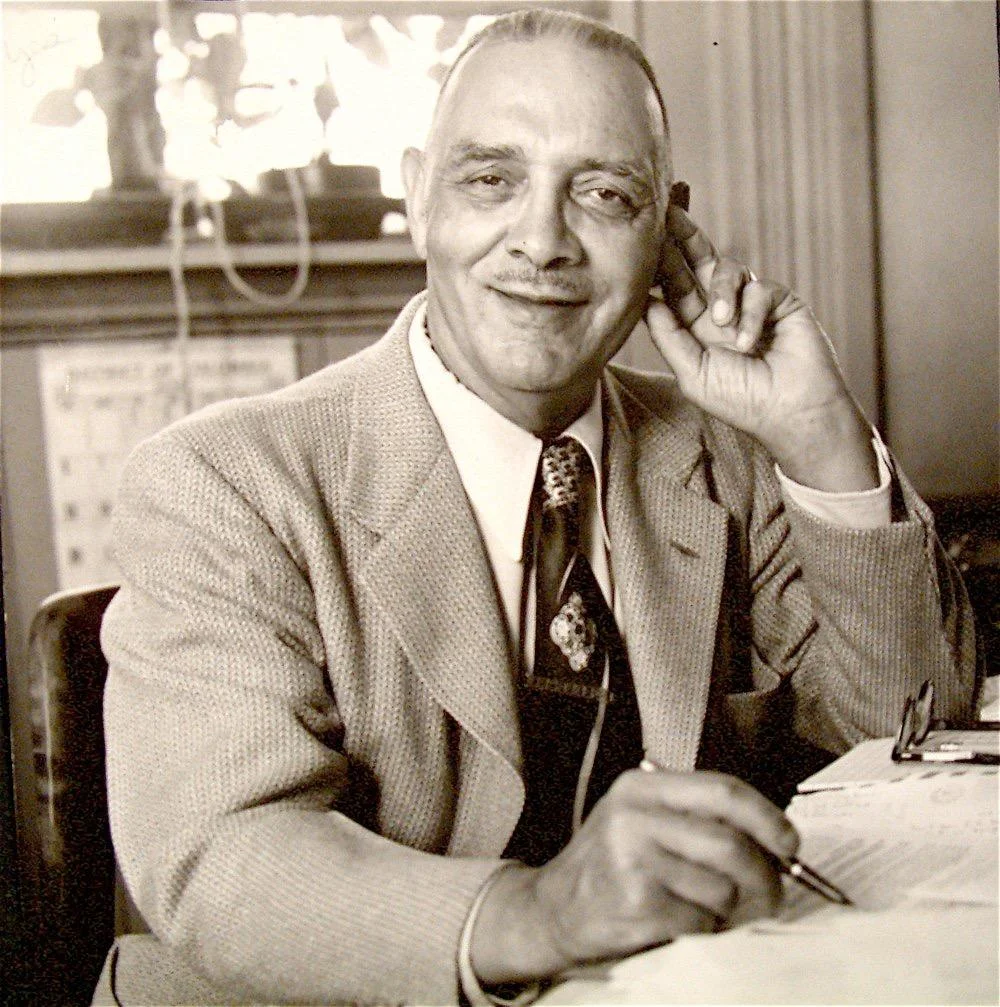
Dr. E.B. Henderson
Dr. Edwin Bancroft Henderson devoted his entire adult life to the struggle for civil rights for African Americans.
E.B. Henderson (November 24, 1883 – February 3, 1977) was an American educator and National Association for the Advancement of Colored People(NAACP) pioneer.
Henderson spent most of his childhood living in an integrated neighborhood and spent his summers in Falls Church, where he learned some of the serious differences between life in a cosmopolitan City and a rural southern town.
Henderson attended Harvard University and became the first African-American male certified as a teacher of Physical Education in public schools.
Integrating Athletics
Henderson devoted much of his professional career to the promotion of athletics in the African-American community. From 1904 until he died in 1977, Henderson was perhaps the nation's leading figure during the 20th century in establishing equal rights and opportunities for Black athletes.
He believed that through the discipline of athletics that African-Americans could break down the barriers of intolerance. Knowing that basketball and other sports might open doors that were otherwise closed to his race in 1904, Henderson helped establish the Interscholastic Athletic Association to foster high school and college athletics in Washington, D.C.’s black community.
In 1907, Henderson introduced the largely segregated sport, basketball to Washington, D.C.. He wasthe captain and star player of the Twelfth Street YMCA, known to this day as the legendary Washington 12th Streeters. He later petitioned Howard University to take on the 12th Streeters as their first varsity basketball team, where they then went undefeated in 1909 and 1910 and captured the national Colored World Basketball Championship among black basketball teams.
Henderson also initiated the Inter-Scholastic Athletic Association of Middle Atlantic States, the Public School Athletic League, and the Eastern Board of Officials for Black Athletics as organizing bodies for African-American sports.
In 1937, Henderson began a 10-year battle to integrate the Golden Glove Boxing Tournament. By 1947, Henderson pressured the Washington Post to sponsor the tournament as an integrated event.
Henderson is also known as the "Grandfather of Black Sport History." In 1910, he published the first in a series of four books. The first, titled "Official Handbook: Inter-Scholastic Athletic Association of Middle Atlantic States," describes the organization of athletics within the segregated African-American community.
The second, "The Negro in Sports," was published in 1939. It was the first compendium ever written about African-American athletics and still stands as the basis for research in the field. The second edition was published in 1949 in response to a growing national interest in the integration of professional sports.
In 1968, he wrote "The Black Athlete: Emergence and Arrival." These books and publications provided a sense of pride and academic distinction that had previously been missing. In 1974, Henderson was inducted as a charter member into the Black Athletes Hall of Fame, along with Muhammad Ali, Joe Louis, Jackie Robinson, Jesse Owens, Althea Gibson, Henry Aaron, and Satchel Paige.
On September 21, 2024, Henderson was inducted into the Naismith Basketball Hall of Fame.
Civil rights
Henderson and Joseph Tinner advanced the cause of civil rights and, in 1918, helped found the first rural branch of the National Association for the Advancement of Colored People (NAACP), paving the way for NAACP rural branches across the South.
In 1912, Virginia authorized towns to establish “segregation districts,” making it legal for local governments to segregate neighborhoods. The U.S. Supreme Court had already cleared the way for local governments to do this. In Plessy v. Ferguson in 1896, the Court ruled that segregation of public facilities was lawful as long as they were “separate but equal.”
Henderson devoted much of his time to promoting the work of the N.A.A.C.P. in the area, ultimately becoming the state President of the Association. His work in equal access for African-Americans in transportation, athletics, education, and all aspects of the social forum is well documented.
He is best known for his letters to the editor. In his lifetime, over 3,000 of his letters to the editor were published. The Washington Post claimed that he was the most published letter writer in their history. His tone was always dignified, but forceful.
To honor Henderson's prolific letter writing and to inspire youth to follow this same path, the Tinner Hill Heritage Foundation, along with the Washington Post and Diener and Associates, CPAs, sponsors the annual E. B. Henderson, "Dear Editor" Contest for high school students in Northern Virginia.
Henderson fought for civil rights on many other fronts. He was instrumental in integrating the entertainment business in Washington, D.C., particularly the Uline Arena in 1944. He also worked with Eleanor Roosevelt on the famous Marian Anderson performance that was banned at the D.A.R. Auditorium and ended at the Lincoln Memorial. In 1937, Henderson began a 10-year battle to integrate the Golden Glove Boxing Tournament. By 1947, Henderson pressured the Washington Post to stop sponsoring the event as a segregated event. When the Post agreed, integration occurred.
In Falls Church, local police brutality in the African-American community was a concern for Henderson. By fighting such injustices on a local level, he again put his safety on the line.
His letter writing on civil rights continued up to his dying day of February 3, 1977, at the age of 93.
His work has been honored and written about by many. In 1982, Fairfax County commemorated the Providence Recreation Center in his name. In 1993, the City of Falls Church designated his home as a historic resource. In 1999, a plaque honoring his achievements was placed at the Tinner Hill arch. In 2000, the Falls Church Community Center gym was memorialized in his name.
More People of Tinner Hill
-
In 1915, a son, Joseph Tinner, joined with neighbor Dr. E. B. Henderson and others to protest a proposed city segregation ordinance that would have forced Black residents to sell their homes and move to one part of town, much like Nazis would do just a few years later in Europe. They formed a group they called the Colored Citizens Protective League, which in 1918 became the first rural branch of the NAACP.
-
Harriet Foote Turner was an enslaved woman who escaped from the nearby Cook -Fitzhugh plantation in the late 1850s (American Battlefield Trust ). Harriet played an important role in the pathway to freedom for many enslaved people in the Falls Church area. In 1858, Harriet used forged passes to lead 12 newly enslaved people to freedom in Canada by posing as their owner (The VDHR Historical Marke r Database ). Harriet Foote Turner, lived where the Falls Church tobacco barns were located on what is now South Maple Avenue. She was the aunt of E.B. Henderson (HOUSE JOINT RESOLUTION NO. 350 - Commending Henderson House ). Harriet Foote Turner is buried at Galloway Methodist Church .
-
George and Harriet Brice were previously enslaved people who became prominent African American landowners of Falls Church. Harriet Brice gained freedom prior to 1860. She lived and owned land in Falls Church at the beginning of the Civil War. George Brice gained freedom after fleeing to the Union in 1861, shortly after in 1863 he joined the 6th Regiment United States Colored Troops. The couple raised their family in Falls Church. Harriet purchased land in 1864. George farmed this land and the land of absent landowners in exchange for a portion of what he grew on the property.
In 1867, George and Harriet Brice helped to buy land for what was then known as Watkins Chapel, now the Galloway Methodist Church (blackpast.org).
-
Louisa Henderson was the mother of E.B. Henderson and the daughter in law of Eliza Henderson. Louisa helped to run Eliza’s grocery store until the 1930’s. She was a member of the nearby Second Baptist Church and donated a portion of the land the church campus sits on today.
-
Frederick Forrest Foote Jr., a prominent African American merchant and landowner was elected as town constable in 1875. He later went on to serve on the Falls Church Town Council for four terms from 1880 to 1889. Foote was the first African American Council Member. Foote owned a popular grocery store in town which was later purchased by his cousin Eliza Henderson. His father, Frederick Forrest Foote Sr., owned over 30+ acres on the east end of Falls Church.
-
Ollie Tinner was a leader in civil rights efforts around education equality, justice in courts, and African American participation in civic and governmental affairs. For over 20 years, he lobbied alongside Mary Ellen Henderson for a new school for African American Children as well as for funding for new school supplies and books for African American children. Ollie was also the author of “The Colored Citizens' News” in the Fairfax Standard. Many of his articles can be viewed on the Virginia Chronicle. Ollie was a member of the nearby Second Baptist Church and is buried there. 3. The Henderson House 307 S Maple Ave | RPC: 52-306-018 Source: Virginia Department of Historic Resources The Henderson House is located at 307 S Maple Avenue. The property is significant as it was home to Dr. Edwin Bancroft Henderson and Mary Ellen Henderson, husband and wife, who were prominent figures in Falls Church and civil rights advocacy. Dr. Henderson was a founding member of the first rural branch of the NAACP in 1915 and Mrs. Henderson was a principal in then segregated Falls Church schools and a mem